
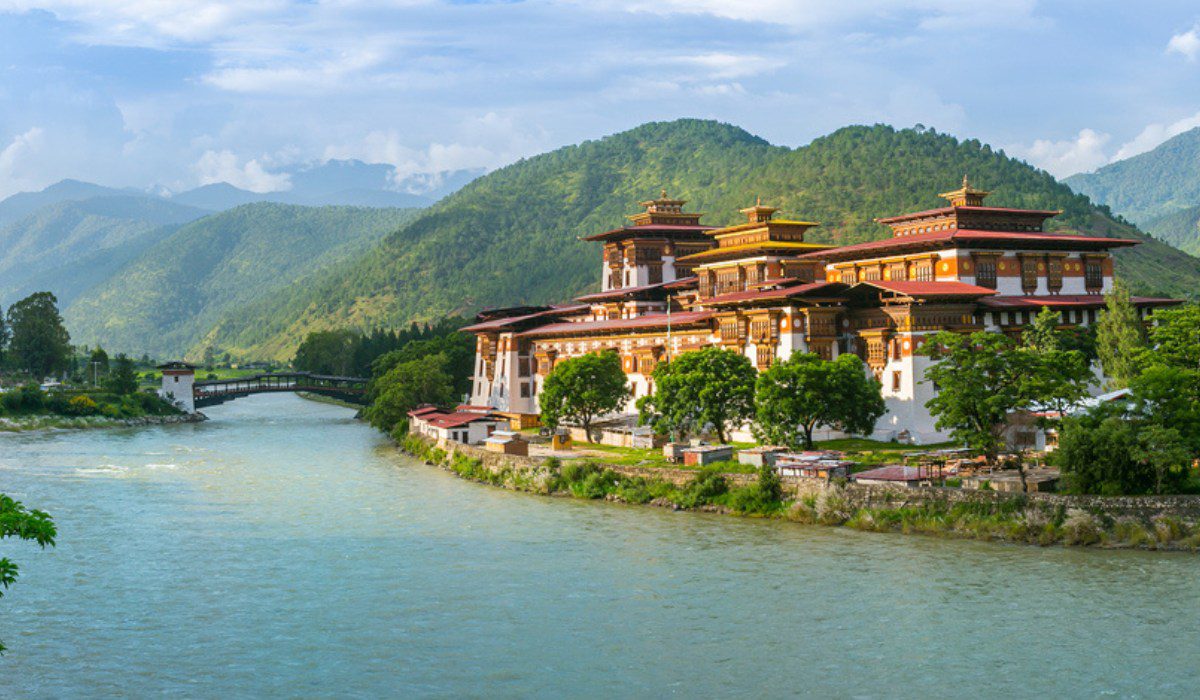
Bhutan is a peaceful Himalayan kingdom known for its stunning natural landscapes, ancient monasteries, vibrant cultural festivals, and the unique philosophy of Gross National Happiness. Often called the “Land of the Thunder Dragon,” it offers a rare blend of spiritual calm, untouched mountains, and warm hospitality.
Location of Bhutan
The Kingdom of Bhutan is a small landlocked country located in the southern foothills of the Himalayan mountain range, sandwiched between the People’s Republic of China to the North and the Republic of India to the south.
Bhutan is a sovereign nation, with a total land area of 38,394 km² and a total population of 788,986 as of Thursday, July 21, 2022.
Bhutan History
Bhutan, the Druk Yul-the land of Thunder Dragon lies between Tibet and India along the slopes of the Himalayas. Bhutan’s early history is steeped in the Buddhist tradition and mythology. The fire and earthquakes have destroyed the original documents of the Bhutanese Pre-history. Some sources say that nomadic herders inhabited Bhutan as early as 2000 – 1500 BC.
The recorded history of Bhutan started from 746 AD, after the visit of Guru Rinpoche to this country. Guru Rinpoche is considered as the second Buddha and the patron saint of Bhutan. He introduces the Buddhist religion in the country-which provides the sense of unity during the medieval ages.
Bhutan was a cluster of fragmented territory, which was constantly at odds with each other in the early 17th century. It was during this time that Zhabdrung Ngawang Namgyel visited the country from Tibet. With his religious powers and strong sense of politics, he unified the country as one nation. He set up a central administration, established a legal system, built many fortress called Dzongs, which were served as and effective defense and to this day; serves as centers of religious & administrations in the country.
The most important thing was happened in the history on 1907, when people elected Sir Ugyen Wangchuck as the first hereditary king of Bhutan unanimously. HRH Jigme Wangchuck succeeded him and ruled the country from 1926 to 1952. HRH Jigme Dorji Wangchuck, also known as the father of modern Bhutan, was king from 1952 to 1972.
Since his coronation in 1974, His Majesty Jigme Singye Wangchuck, the fourth King, has dedicated himself to defining and realizing a long-term vision and direction for the country. He promoted an approach of development known as Gross National Happiness (GNH) which calls for careful balance between creation of material wealth and the spiritual, cultural and social needs of the society. He also pursued a process of democratization and involvement of the people in their own affairs from the national to the community level.
On 14 December 2006, His Majesty Jigme Singye Wangchuck voluntarily abdicated the throne and handed over the responsibilities of the Monarch and the Head of State to the Crown Prince His Royal Highness Jigme Khesar Namgyel Wangchuck who has since assumed responsibilities as the Fifth King of Bhutan.
His Majesty the King Jigme Khesar Namgyel Wangchuck was adorned with the Raven Crown at an ornate coronation ceremony in Thimphu on 6 November 2008, becoming the world’s youngest reigning monarch and head of the newest democracy.
Bhutanese Language
The National language of Bhutan is Dzongkha and literally Dzongkha means the language spoken in the Dzongs and administrative centers in all the districts of Bhutan – Bhutanese Language.
The national language is Dzongkha, the native language of the Ngalops of western Bhutan. Dzongkha literally means the language spoken in the Dzongs, massive fortresses that serve as the administrative centers and monasteries. Two other major languages are the Tshanglakha and the Lhotshamkha. Tshanglakha is the native language of the Tshanglas of eastern Bhutan while Lhotshamkha is spoken by the southern Bhutanese of Nepali origin.
Other dialects spoken are Khengkha and Bumthapkha by the Khengpas and Bumthap people of Central Bhutan. Mangdepkah, which is spoken by the inhabitants of Trongsa and the Cho Cha Nga Chang Kha which is spoken by the Kurtoeps. The Sherpas, Lepchas and the Tamangs in southern Bhutan also have their own dialects. Unfortunately two dialects that are on the verge of becoming extinct are the Monkha and the Gongduepkha.
There are also as many as nineteen major dialects or languages which have survived in the country. The richness of the linguistic diversity can be attributed to the geographical location of the country with its high mountain passes and deep valleys. These geographical features forced the inhabitants of the country to live in isolation but also contributed to their survival.
Getting to Bhutan
Entry by Air
Bhutan’s airlines Druk Air and Bhutan Airlines operate several flights per week from Bangkok, Delhi, Kolkata, Bodh Gaya, Dhaka, Guwahati and Kathmandu and Singapore to Paro. The modern Airbus A-319 jets carry passengers through one of the most spectacular flight paths in the world. If you are flying in, do not forget to ask for left-side seating to enjoy majestic views over the Himalayan mountain ranges. permitting; passengers will be treated to intimate views of Mt. Everest, Lhotse, Makalu and Kangchenjunga. Landing in the Paro Valley, surrounded by 4000 meter high mountains stretching across the west of Bhutan, means a visual landing is the order of the day. The Bhutan’s only international airport at Paro, is located at a height of 7300 ft above sea level. The only other domestic airline is in Bumthang valley with 3 flights a week from Paro to Bumthang and back on the same day. Those visitors who visit Bumthang are advised to take the domestic flight back to Paro in order to reduce significant drive time. Domestic flights are also as safe and reliable as the international flights.
Entry by Road
Phuntsholing, Gelephu and Samdrup Jongkhar in eastern Bhutan are the only land border areas open for international tourists. The town of Phuntsholing is located approximately 170 km east of the Indian national airport Bagdogra. After crossing Phuntsholing, your journey then begins its mountainous climb through endless turns and hair-pin bends till you enter Thimphu, the capital city. The travel time for the 176 km stretch can be more than 6 hours.Gelephu in South-Central Bhutan is another entry point to Bhutan. It is approximately 250 kms from Thimphu and the journey will take you through the sub-tropical areas of Bhutan before entering the alpine zone and then finally into Thimphu. One will have to traverse across three Districts and the travel time will be about ten hours.Samdrup Jongkhar is the only entry point in eastern Bhutan. The town borders the Indian district of Darranga, Assam and is approximately 150 kms away from Guwahati, the capital city of Assam. The journey from Guwahati is about three hours. Tourists entering Bhutan through Samdrup Jongkhar will take you to Trashigang, the largest District in the country, and from there over the lateral route to Mongar, Bumthang, Trongsa, Wangde Phodrang and then finally into capital, Thimphu. The distance is about 700 kms and will take you a minimum of three days to reach Thimphu.A combination of overland and air travel is also possible. All overland travel requires an Indian visa.
Best time to visit Bhutan
Spring (March, April & May)
Spring is one of the best season for travel enthusiasts to visit Bhutan. This is the period of the year when every places within Bhutan embraces a new outlook with fresh air and favorable climatic condition across the country. During spring, temperature remains moderate at lower elevation like Gelephu, Phuentsholing, Samdrupjongkhar & Panabng while places located at greater height enjoys pleasant climatic conditions with temperatures varying from 2℃ to 12℃.
For travelers planning for a trip to Bhutan during spring, they are always welcomed by a range of places to visit in Bhutan in spring and an array of exciting things to do within the country. Also, as spring marks the onset of a comparatively clear sky, this season proves to an ideal time to embark on sightseeing tours, enjoy panoramic views of the Himalayan Range, and lot more. Spring has also been a perfect time of year for visitors to witness the numerous cultural displays of Bhutan.
Autumn (September, October & November)
Autumn is the time of the year for trekkers, travelers, and photographers. The temperature during this time is cool and pleasant with transfixing blue skies. A perfect time for escaping reality in the peaceful monasteries and interacting with the monks, learning their simple ways of life. Also, this is when Bhutan hosts the Thimpu Tshechu festival and black-necked crane festival. The temperature stays between 13 to 25 degrees.
Summer (June, July & August)
Summer starts in the month of June and extends up to August. This is the best season for travelers who want to catch a closer and clear look of the Himalayan Kingdom of Bhutan when amazed by the lush green paddy fields, landscapes and influx of birds and animals.. Also, its best time of the year for those who just want to unwind from the comfort of their balconies with a splendid view. Bhutan receives more heavenly showers than any region of the Himalayas. So monsoons are quite a romantic time
The temperature in Bhutan around this time goes back and forth between 24 and 25 degrees Celsius approximately.
The weather of places located at greater altitude is often clear and with mild humidity filling the air. A major misconception during the summer is that Bhutan is surrounded by rainy clouds of the monsoons. However, that’s not true. Monsoon in Bhutan is restricted to mild afternoon showers that happen once every two or three days and the country remains comparatively dry during these months.
Summer marks the onset of the Haa festival, which is celebrated amidst high altitude alpine forests, meadows and lakes and is usually the celebration of the Bhutanese religion, local cuisines and delicacies and cultures.
Winter (December, January & February)
Winter is cold here amidst the mountains. There will be snowfall and the mercury dips considerably during January. The valley, however, experiences the occasional sunny day with a marvelous blue sky. Visit if you like off season quiet and want to witness the Trongsa Tshechu – an exclusive affair with very little tourist presence, this could prove to be a special experience.
Bhutan Visa
Bhutan Visa is a very important document for all visitors to Bhutan. Oriental Travel Planner will process your Visa through Tashel Online System. We need the scanned copy of your passport that you will be carrying while traveling to Bhutan for an online application to process.
Then the Tourism Council of Bhutan (TCB) will process once the full payment of your holiday is received in the Tourism Council of Bhutan’s bank account. No foreign missions or embassies abroad sanction Bhutan Visa. Once received the payment, we will process it within 72 working hours. Once approved the soft copy will be emailed to you. At your point of entry, you will be required to show your visa clearance letter, the visa will then be stamped into your passport.
The Visa is the most essential documents to visit Bhutan. Without it, your entry to Bhutan will be not permitted. Only the registered Bhutanese Tour Operator can process it on behalf of you. All tourists must obtain a visa clearance prior to travel to Bhutan.
For more information visit Tourism Council Bhutan’s website https://www.bhutan.travel/page/visaentry-permit
Customs Duties
Visitors are required to fill out a Custom Form upon arrival. The following articles are exempt from duty: (a) Personal effects and articles for day to day use by the visitor
(b) 1 litre of alcohol (spirits or wine)
(c) Instruments, apparatus or appliances for professional use
(d) Photographic equipment, video cameras and other electronic goods for personal use. The articles mentioned under (d) & (e) must be declared on the declaration form. If any such items are disposed of in Bhutan by sale or gift, they are liable for customs duty.
On departure, visitors are required to surrender their forms to the Customs authorities.
Import/export restrictions of the following goods is strictly prohibited:
(a) Arms, ammunitions and explosives
(b) All narcotics and drugs except medically prescribed drugs
(c) Wildlife products, especially those of endangered species
(d) Antiques, Imports of plants, soils etc. are subject to quarantine regulations. Visitors are advised to be cautious in purchasing old and used items, especially of religious or cultural significance; as such items may not be exported without a clearance certificate. Always ask your guide if you have any questions while shopping certain antiques.
Bhutan Trekking Tips
Trekking Gear
Please note that there are no trekking equipments available in Bhutan; although we provide trekking equipments like Trekking Tents and cooking utensils on the trek. Others you must bring everything yourself. Everything mentioned on the list are useful, and most of the things are need on long trek.
Footwear
trekking or running shoes
camp shoes or thongs
socks
polypropylene
Clothing
down or fiber-filled jacket
jumper or pile jacket
hiking shorts (for man) or skirt (optional)
waterproof jacket, poncho or umbrella
hiking pants
T- shirts or blouses
underwear
sun hat
swimwear (optional)
Other Equipment
rucksack
sleeping bag
water bottle
torch
Miscellaneous Items
toilet articles
toilet paper and cigarette lighter
small knife
sun block
towel
laundry soap
medical and frist aid kit
pre-moistened towelettes
sewing kit
bandanna
Bhutan Tour Guides – Guides of Bhutan
Bhutan Tour guides have important responsibilities to fulfill with regard to how they interact with our tourists, how they promote the company and the country as a tourist destination. As guides, they represent not only themselves to the tourist, but also represent their company for which they are working, and to a great extent, our country-Bhutan. Therefore, we can say that they are the ambassadors of the company and the country. They are the first and last person to deal with our guests in the field. They are the main element in delivering the highest possible quality service to our visitors. Our guests will think or assume about our country, people in accordance to our guide’s performance, the knowledge, and the services they render to them. For instance, if our guide’s performance is excellent and satisfactory to our guests, then they will have a very good impression of our country, people as a whole. All and all, it is the responsibility of the guides to make Bhutan an ideal tourist destination.
Therefore to ensure to receive high quality and professional services, we provide well-trained, professional tour guide licensed the holder to all our visitors.
Bhutan Tourism Policy
Bhutan Tourism has a new pricing system for all guests ( except Indians , Maldives & Srilanka Nationals) visiting Bhutan. Guests will pay a Sustainable Development Fee (SDF) of USD 100 per night per person.( subject to be changed). SDF Fees for the Indian National@1200 Rs. per person per night. SDF is to promote sustainable and responsible tourism under the overall principle of “High Value, Low Volume” tourism in Bhutan. SDF contributes to social welfare, developmental activities, conservation of the environment, promotion of culture, and enhancement of infrastructure and facilities for guests.
Children between Six and 12 years would receive the concessionary levy rate of 50 percent on SDF and Five years below will be no SDF charges.
On top of the SDF, guests also have to pay for airfare, accommodation, transportation, meals, guide services, and many more while guests are in the country.
M/s Oriental Travel Planner, we will send you the invoice, including the SDF and other charges, once you confirm your travel dates and others for your kind approval and confirmation.
Hotels Standard
Bhutan’s government as rolled out a Star Classification System to accredit hotels and accommodation providers for visitors, However, it is important to note that the Star Classification is NOT at par with the international Star Accreditation System. Therefore, please do not expect a 3-star or a 4-star hotel in Bhutan to be the same as in a developed city in the world. Hotels and guesthouses in Bhutan have comfortable rooms with basic amenities and a traditional ambience. Generally, hotels in western Bhutan are better appointed, while accommodation establishments in the central and eastern part of the country are more modest, with fewer amenities. The majority of hotels in Bhutan are 3-Star properties. Four and Five star luxury properties are available now in certain places. Accommodation in all resorts, hotels, lodges or inns, is in standard rooms, unless otherwise stated. If you have any special request for certain services, please advise us so that we could notify your hotel, but we cannot guarantee that it will be accommodated.