
Thimphu is a bustling town on the bank of Thimphu Chu & set gloriously in the hills of the Thimphu valley. Thimphu is the capital of Bhutan and it is the centre of Government. It is situated in the western central part of Bhutan and the name of the surrounding valley is Dzongkhag, the Thimphu District. The city became the capital of Bhutan in 1961.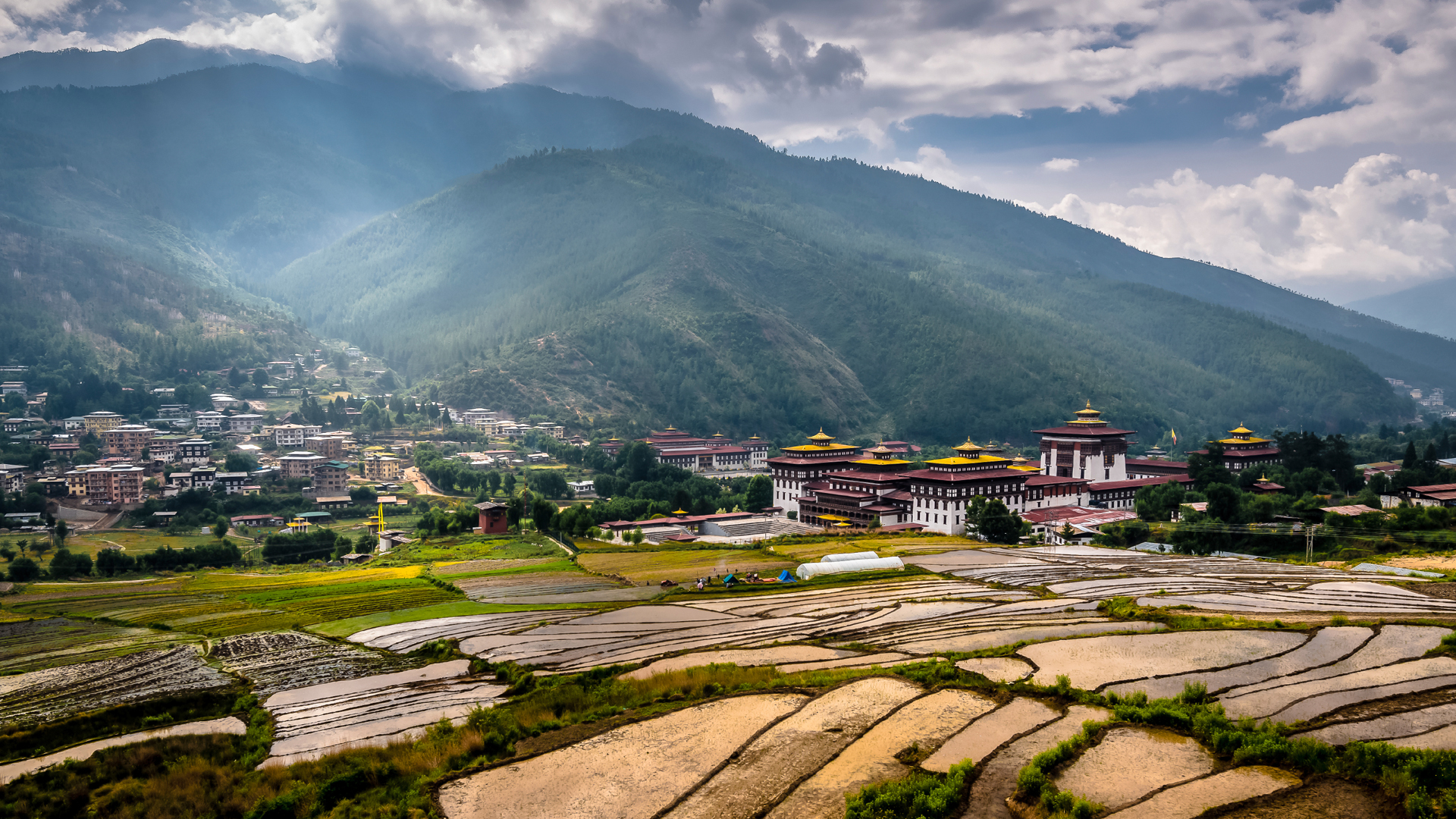
The name ‘Thimpu’ originates from a sinking stone in front of Dechenphu monastery. ‘Thimpu’ means to sink and ‘phu’ meaning to fly in local language. Oral history says that the stone is placed on top of a subdued ogress to prevent her from flying away.
It has an interesting combination of tradition and modernity, and includes some of the most advanced and remotest parts of the kingdom. It is the home of the Bhutanese Royal family, Civil servants & Expatriates.
The culture of Bhutan is fully reflected in Thimphu in respect of literature, religion, customs, and national dress code, the monastic practices of the monasteries, music, dance, literature and in the media. Tsechu festival is an important festival when mask dances, popularly known as Cham dances, are performed in the courtyards of the TashichhoeDzong in Thimphu.
Roam Around ……..
Memorial Chorten: The Memorial Chorten, also known as the Thimphu Chorten, situated in the centre of ThimphuCity. The chorten, built in 1974 to the honour of 3rd King of Bhutan, is a prominent landmark in the city with its golden spires and bells. It is popularly known as “the most visible religious landmark in Bhutan”.
Changangkha Monastery: ChangangkhaLhakhang is one of the oldest monasteries in the Thimphu valley. It was built in the 15th century by a descendant of Lama Phajo, the man who spread the sect drukpakagyu in Bhutan. The main statue at the temple is of Avalokiteswara (the eleven-headed Buddha manifestation with 1000 arms and 1000 eyes). The temple courtyard offers good views over the city of Thimphu.
Simtokha Dzong: SimtokhaDzong, known as SangakZabdhonPhodrang (Palace of the Profound Meaning of Secret Mantras) is said to be the oldest surviving fortress cum monastery established in 1629 by ZhabdrungNgawangNamgyal, who unified Bhutan. It was attacked several times in the 17th century but survived and was refurbished repeatedly. It is a small dzong (only 60 metres (200 ft) square with gate on the southern direction), located about 5 kilometres to the south of Thimphu. It now houses one of the premier Dzongkha language learning institutes namely, “The Institute for Language and Culture Studies.” Both monks and common people study here. Students who graduate from this school primarily become Dzongkha teachers.
National Zoo: Contains national animal Takin. The Takin is a goat-antelope found in the Eastern Himalayas. Bhutan selected the Takin as the national animal based on both its uniqueness and its strong association with the country’s religious history and mythology.
National Library: The National Library was established in 1967 to preserve many ancient Dzongkha and Tibetan texts. (9am – 4pm, Closed on Sunday, Monday & National Holidays)
BBS Tower: It is located North West of the ThimphuValley. The Places has the top hill which gives a clear view of the entire Thimphu valley in a nutshell and the feeling from there is just fantastic.
Folk Heritage Museum: The house replicates a traditional farmhouse and is furnished as it would have been about a century ago. A guided tour of this almost-living museum is included in the admission and provides a glimpse into traditional Bhutanese life. The house design and many of the implements are also reminders of how many rural Bhutanese still live today. Bring a torch (flashlight) as some of the rooms are quite dimly lit.
National Textile Museum: This museum is worth a visit to get to know the living national art of weaving. Exhibitions introduce the major weaving techniques, styles of local dress and textiles made by Bhutanese. (Everyday 9am – 4pm & Saturday 1pm – 4pm, Sunday 10am – 3pm, Closed on Monday & National Holidays)
School of Arts And Crafts: The School of Arts and Crafts, commonly known as painting school, offers an eight year course which provides instruction in many of Bhutan’s traditional arts to boys throughout the country. (Everyday 2pm – 4pm & Saturday 9am – 12noon, Closed on Sunday & National Holidays)
National Institute of Traditional Medicine: This institute was established in 1978. It prepares and dispenses traditional herbal and other medicines. There is an impressive laboratory and production facility that manufactures quality products. All kinds of pills, tablets, ointments and medicinal teas from here are distributed to regional health-care units around the country.
Jungshi Handmade Paper Factory: This small factory produces watermark paper as well as cards, lampshades, envelopes, calendars and other items made from traditional Bhutanese paper.
Tashichho Dzong: TashichhoDzong, “Fortress of the Glorious Religion”, is the most stately and most impressive building in Bhutan. The dzong housed the original National Assembly and now houses the secretariat throne room and the offices of the King of Bhutan. Visit to TashichhoDzong permitted only after office hours (4pm – 5pm) in winter months when the monk body is not in Thimphu.
Weekend Market: Every Saturday & Sunday most of the Thimphu population congregate on the banks of the river, where the weekend market is held. Here villagers from the valley & other nearby places come to sale their agricultural products.
Dechen Phodrang Monastery: DechenPhrodrang means “Palace of Great Bliss.” It is a Buddhist monastery located to the north of Thimphu. The Dzong located at the end of Gaden Lam was originally the site of Thimphu’s original TashichhoeDzong. In 1971, it was converted into a monastic school with 450 student monks enrolled for eight-year courses. It has a staff of 15.The monastery contains a number of important historical Bhutanese artifacts including 12th century paintings monitored by UNESCO and a noted statue of Namgyal on the upper floor. In the downstairs chapel, there is a central SakyamuniBuddha.
Dechencholing Palace: Dechencholing Palace is located to the northern end of the Thimphu valley on the east bank of the ThimphuChuu. It was the residence of the late Royal Grandmother, popularly known as GayumPhuntshoChodenWangchuck. King JigmeSingyeWangchuck was born here on 11 November 1955, but currently makes his residence at the Samteling Palace (Royal Cottage). The palace is frequently used for international delegations, especially those with India. Indian ambassadors regularly visit the palace to discuss international relations between India and Bhutan. It is also the venue for hosting luncheons and banquets for Head of the States and other important guests of Bhutan
Cheri Monastery: Cheri Monastery also called ChagriDorjeden Monastery was established in 1620 by ZhabdrungNgawangNamgyal; the first monastery established by him at a young age of 27. Zhabdrung spent three years in strict retreat at Chagri and resided there for many periods throughout the rest of his life. It was at Chagri in 1623 that he established the first Drukpa Kagyu monastic order in Bhutan. The monastery, which is now a major teaching and retreat centre of the Southern Drukpa Kagyu order, is located at the northern end of ThimphuValley, about 15 kilometres (9.3 mi) from the capital. It sits on a hill above the end of the road at Dodeyna and it takes about an hour’s walk up the steep hill to reach the monastery from there. According to Bhutanese religious histories, the place was first visited by Padmasambhava in the 8th century. In the 13th century, it was visited by PhajoDrugomZhigpo, the Tibetan Lama who first established the Drukpa Kagyu tradition in Bhutan. There is a silver chorten inside the monastery that enshrines the ashes of Zhabdrung’s father.
Tango Monastery: The Tango Monastery is located to the north of Thimphu near Cheri Mountain. It was founded by Lama GyalwaLhanampa in the 13th century and built in its present form by Tenzin Rabgye, the 4th Temporal Ruler in 1688. According to local legend, the location of this monastery is the holy place where Avalokiteshvara revealed himself as “the self-emanated form of the Wrathful Hayagriva”. The location had been prophesised in Tibet. In 1616, the Tibetan, ShabdrungNgawangNamgyal, meditated in its cave. It belongs to the Drukpa KagyuSchool of Buddhism in Bhutan. The word ‘Tango’ in Bhutanese language means “horse head”. This name conforms to the main deity Hayagriva (local name Tandin) deified in the monastery. Tango Monastery is built in the dzong fashion, and has a curved (semi-circular) outside wall and prominent main tower with recesses. It covers the caves where originally meditation and miracles were performed by saints from the 12th century onwards Behind the series of prayer wheels are engraved slates. Inside the courtyard is a gallery, illustrating the leaders of the Drukpa Kagyupa lineage.
Buddha Dordenma: The Buddha Dordenma is a bronze statue, a ‘Vajra Throne’ Buddha, that is under construction amidst the ruins of KuenselPhodrang, overlooking Thimphu city, about 100 metres (330 ft) above the Wang Chuu river bed. This location was the palace of SherabWangchuck, the 13th DesiDruk. It is a gigantic Shakyamuni Buddha statue under construction. The statue will house over one lakh (one hundred thousand) smaller Buddha statues, each of which, like the Buddha Dordenma itself, will be made of bronze and gilded in gold. Upon completion, it will be one of the largest Buddha rupas in the world, at a height of 51.5 metres (169 ft). The statue alone is being built at a cost of US$47 million, by Aerosun Corporation of Nanjing, China, while the total cost of the Buddha Dordenma Project is well over US$100 million.The interior will accommodate 100,000 8-inch-tall and 25,000 12-inch-tall gilded Buddhas respectively. It is planned to be completed by October 2010 Apart from commemorating the centennial of the Bhutanese monarchy, it fulfils two prophecies. In the 20th century, the renowned yogi SonamZangpo prophesied that a large statue of either Padmasambhava, Buddha or of a phurba would be built in the region “to bestow blessings, peace and happiness on the whole world”. Additionally the statue is mentioned in the ancient terma of Guru Padmasambhava himself, said to date from approximately the 8th century, and recovered some 800 years ago by tertonPemaLingpa.
Motithang Takin Preserve: Thimphu is a wildlife reserve area for takin, the National Animal of Bhutan. Originally a mini-zoo, it was converted into a preserve when it was discovered that the animals refrained from inhabiting the surrounding forest even when set free. The reason for declaring the takin as a National Animal of Bhutan on 25 November 2005 (Budorcastaxicolor) is attributed to a legend of the animal’s creation in Bhutan in the 15th century by Lama DrukpaKunley. The King of Bhutan believed that it was improper for a Buddhist country to confine animals for religious and environmental reasons, so he ordered the closure of the mini-zoo and the release of the animals into the forest. However, the Takin remained rooted to the town and were seen straying in the streets of Thimphu in search of fodder. Hence, an exclusive preserve was created for them to live freely.
Zangtho Pelri Lhkhang: This lhkhang was built in 1990s by DashiAkuTongmi, who was a great musician . The lhkhang is a replica of Guru Rinpoche’s cel;estial abode. The chapel is located just next to the lower market , popularly known as Sabji – Bazaar.
The beautiful valley is home to many of Bhutan’s oldest monasteries & temples. The valley is also home to Mount Chomolhari (7300 mtr.) situated at the northern end of the valley whose glacier, water forms the Pa Chu which is flowing through the valley.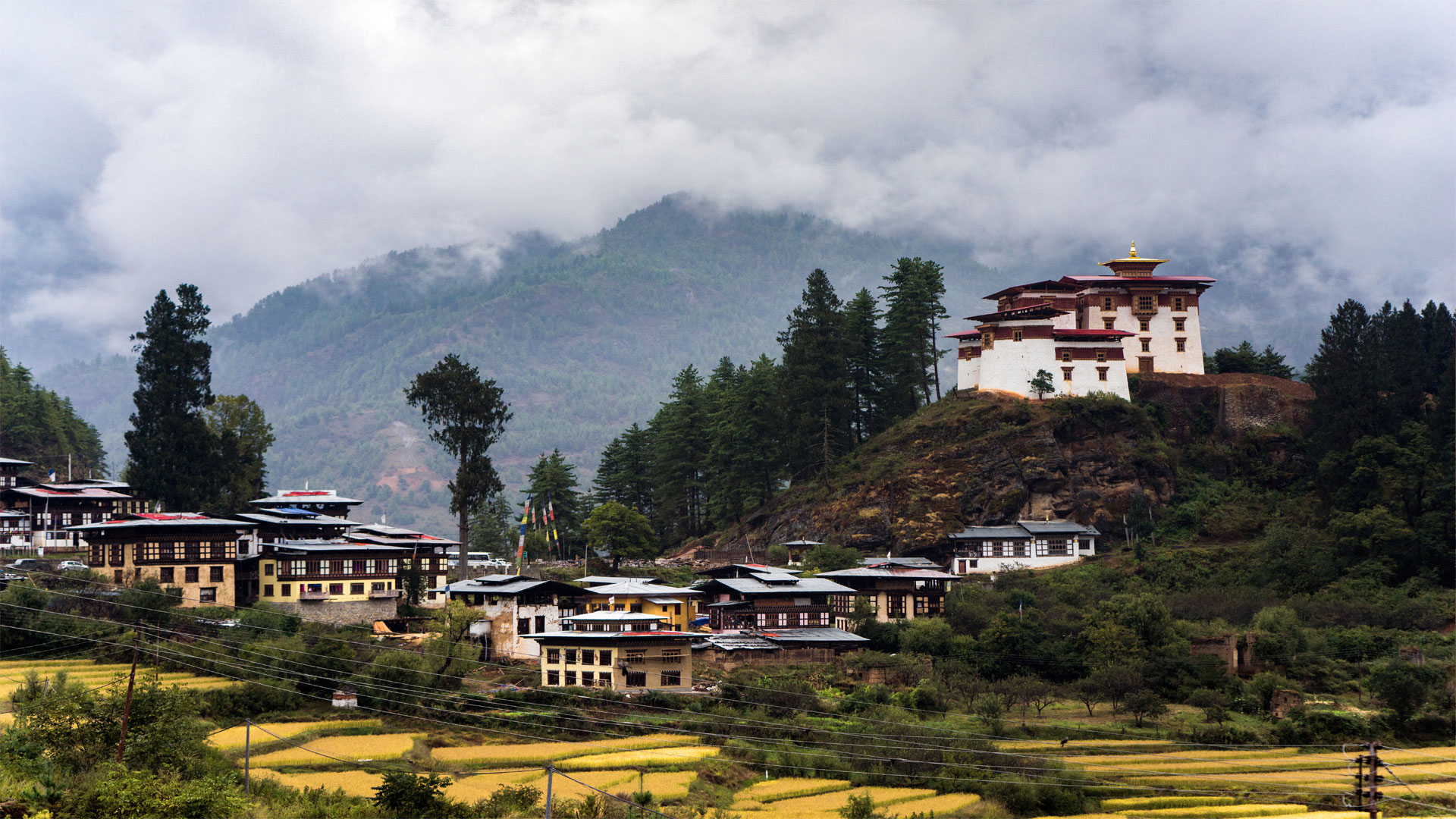
Paro is bordered by Haadzongkhag to the west, Tibet to the north, Thimphu to the east, and Chukhadzongkhag to the south.
Paro contains the only active international airport in Bhutan, the Paro Airport, a beautiful small green-roofed facility in a valley, served only by Drukair (Bhutan’s National Airline) from India and other countries in Southeast Asia.
Roam Around ……..
Ta Dzong: It is aunique museum. Located inside the circular 7th century fort is the national museum of Bhutan with its wonderful and varied collection. It provides an excellent introduction to Bhutanese art and culture. (9am – 4pm, Closed on Sunday, Monday & National Holidays)
Rinpung Dzong: The massive three hundred and fifty year old fort is the center of governance for the Province of Paro. The governor, the chief judge and other government official keep office within the walls of this fort following old traditions. Half the fort is permanently occupied by 200 resident monks. Every year in the spring, the fort host’s one of theBhutan’s biggest religious festival.
The Ruin of Drukgyel Dzong: This fort is fifteen minutes’ drive from Zhiwa Ling and set on a hill with a spectacular view of the valley.This fort protectsfrom Tibetan invasions.It provides a wonderful architectural insight to the structure of forts in Bhutan. Drukgyel is also the starting point of Bhutan’s most famous trekking routes.
Kichu Lhakhang: It is one of the oldest monasteries in the country built in the 7th century by the Tibetan King SongstenGampo. The story goes that a giant demoness lay across the whole area of Tibet and the Himalayas and was preventing the spread of Buddhism. To overcome her, King SongtsenGampo decided to build 108 temples, which would be placed on all the points of her body. Of these 108 temples, 12 were built in accordance with precise plans. This is one of the oldest monasteries in Paro district. There’s a belief that the two orange trees here in KyichuLakhang bears fruit throughout the year.
Chele-La-Pass (Full Day): Chele-La-Pass, at an elevation of 13,088 ft., is considered to be one of the highest motorable pass in Bhutan. About an hour’s drive from Zhiwa Ling it passes through lush valleys, pine and rhododendron forest. The pass provides stunning views of the sacred mountain Jomolhari and Jichu Drake.
Drukgel Dzong: This Dzong, with a delightful village nestling at its foot, was built in 1646 by ZhabdrungNgawangNamgyal to commemorate his victory over the Tibetan invasions. “Druk” means the land of the thunder dragon or the land of dragon people;”Gyel” means victory. The dzong caught fire in 1951 and now it only remains as ruin. This dzong is built at a strategic point where the route from Tibet enters the Paro valley. Later when the invasions ceased , this route was used for trade between Tibet and Bhutan. On a clear day, one can see the beautiful view of the majestic mountain Jomolhari from the village, below the Dzong.
Taktsang monastery (Full Day): Taktsang Monastery is situated on a nearly vertical cliff at 3000mtr altitude north of Paro in Bhutan. It is also known as “Tiger’s Nest” because it is said that Guru Rimpoche have flown on the back of a tigress in the 8th centuryand he meditated in a cave here for three months where the monastery was built. The cave is said to be the origin of Buddhism in Bhutan.
Ugyen Pelri Palace (Palace on Wheels): It was built in 1930 by ParoPenlop, TsheringPenjor. It is believed that a carpenter was sent to India to get a sample and the carpenter without any formal education made the sample out of a pumkin.It is also believed that the palace usedto be on wheels , hence known as palace on wheels. On the road beside the palace are the five square chortens that were built in memory of the first King, UgyenWangchuk.
Haa: Haa District is one of the 20 dzongkhag or districts comprising Bhutan. As per the 2005 census, the population of Haadzongkhag was 11,648, making it the second least populated dzongkhag in Bhutan after Gasa. The dominant language of the district is Dzongkha, the national language. Haa’s major feature is the Haa Valley, a steep north-south valley with a narrow floor. The name Haa (pronounced “hah”), as well as the more ancient name Has connotes esoteric hiddenness. An alternative name for the district is “Hidden-LandRiceValley.”
Punakha served as the capital of Bhutan until 1955. It’s the winter seat of the Je Khempo (Chief Abbot) & the monk body. It has a temperate climate & its rich fertile valley is fed by the Pho Chu & Mo Chu rivers.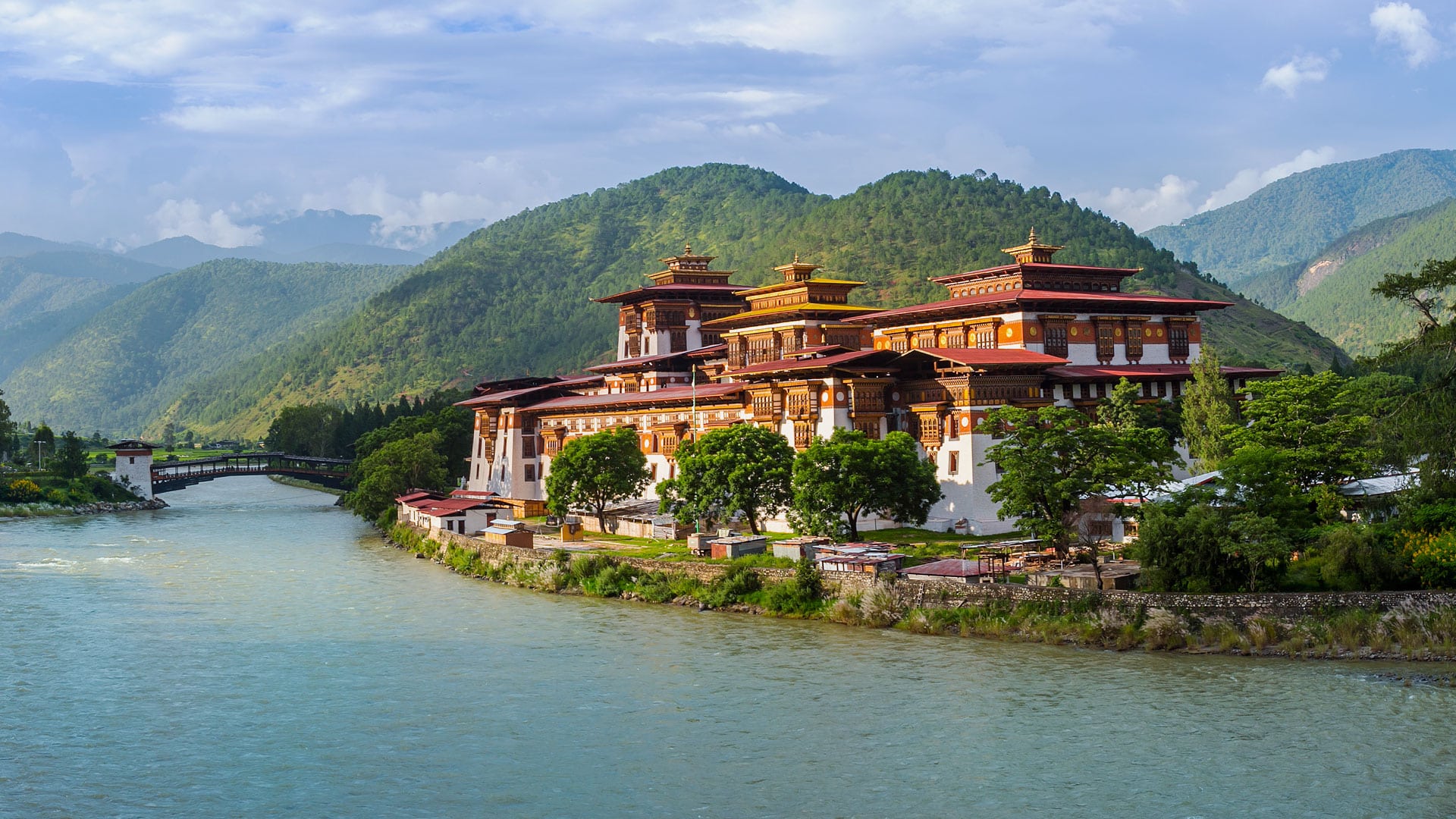
Roam Around ……..
Dochu-La-Pass: Dochu-La-Pass (10,170 feet), is 16 km far from Thimphu and some 30 minutes drive. You will admire the sterling view of snow-capped Himalayas and the hundreds of “broadcasting” prayer flags. During winter road to Dochula pass is covered with mild snow. Prime attraction to visit Dochula pass is 108 chortens / stupas.The sharp peak that stands at the Dochula pass is dominating the region.
Punakha Dzong
Punakha Dzong: The Punakha Dzongwas known in ancient times as the Druk Pungthang Dechhen Phrodang or “The palace of great happiness”. It was built in 1637. This gigantic dzong was damaged 6 times by fire, once by flood and once by an earthquake. It is the second dzongto be built in Bhutan and was the seat of government when Punakha was the capital of Bhutan. Today, the dzong is the winter home for the clergy. The spectacular Kuenrey (assembly hall) in Punakha Dzong is unique which is now open for tourist. Closed in winter months when the monk body is in Punakha.
Chimi Lhakhang: Chimi Lhakhang is a very popular and revered temple that lies on the periphery of the fertile valley of Lobesa, where the borders of Thimphu, Punakhaand WangduePhodrang districts meet. Being dedicated to Lama Drukpa Kuenley, the Divine Madman, the temple is popularly considered to be a temple of fertility.
Wandgue Dzong: It’s an easy drive to the very impressive 17th century Wangdue Phodrang Dzong, home of over 200 monks and a monastic school. The dzong is the largest wood roofed dzong in Bhutan and the style and architecture is very grand.
Gantey Gompha & Phobjika Valley (Full Day): Situated south of the road and east of WangduePhodrang, is GanteyGompa, an old monastery dating back to the 17th century. The gompa, on the valley floor, is the village of Phobjika. This is the winter home of the famous black-necked cranes. The cranes migrate from the high plains of the Tibetan plateau in winter to the milder climate of Phobjika.
Phuentsholing is the gateway to Bhutan by road and it is a thriving centre on the northern edge ( West Bengal) of the Indian Plans. Situated directly at the Himalayan foothills, Phuentsholing is a fascinating mixture of Indian and Bhutanese, a perfect example of mingling of people and their culture. Being the frontier town Phuentsholing serves as the convenient entry / exit point for Bhutanese and foreigners.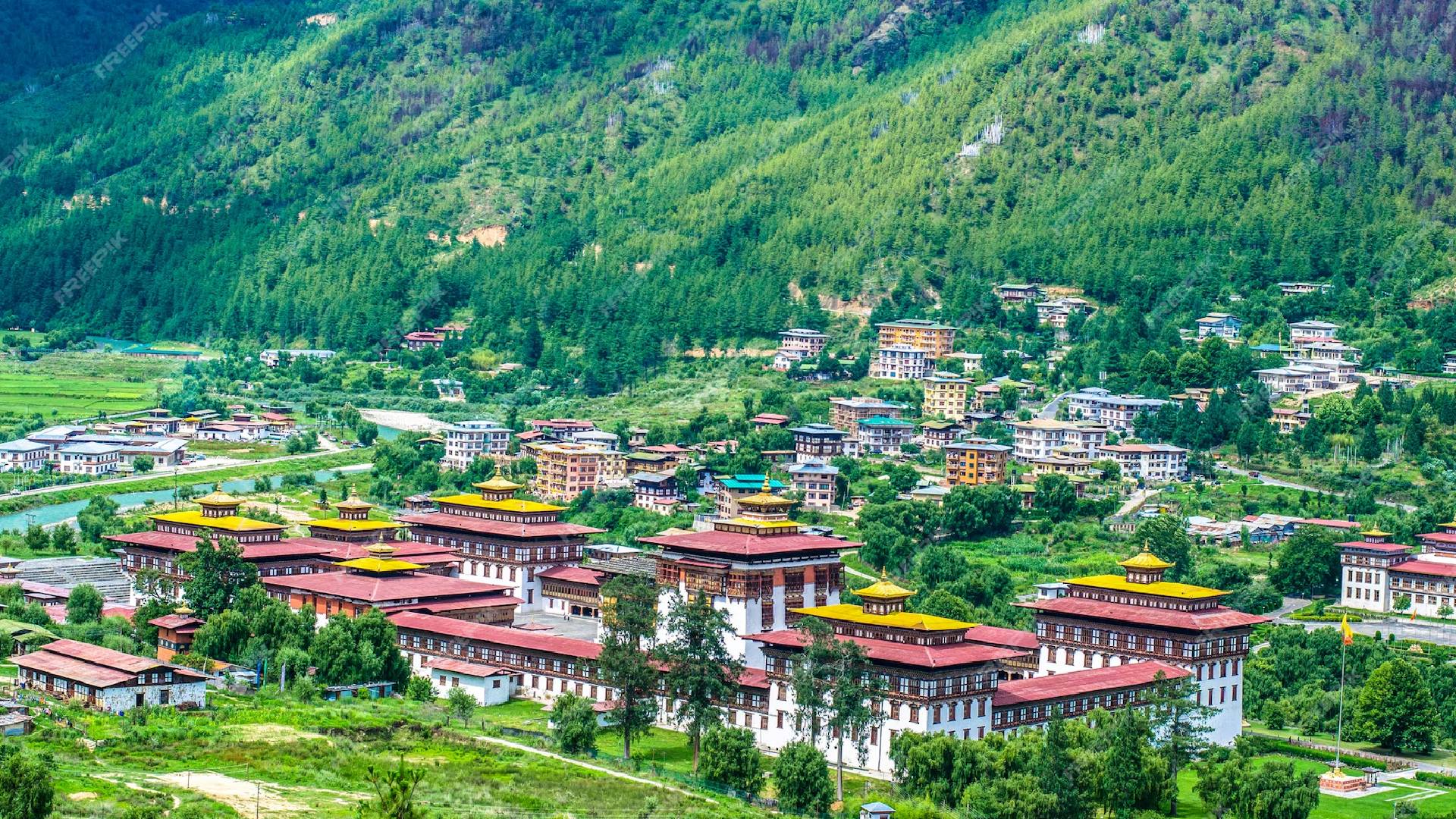
There is a stark contrast in the culture across the border, which is separated by a long wall with a single Bhutanese gate. Locals can sometimes even cross without being asked for papers, but visitors without an Indian passport will need a visa presented by a hired registered tour guide; even one’s Indian Voter ID card will suffice within the town of Phuntsholing, but beyond that one needs the above mentioned documents. The gate is manned by Bhutanese Army guards. The terrain inclines soon after the gate.
The border clearly separates two very different peoples and cultures. Jaigaon is bustling and loud, similar to many other West Bengal centers of commerce, albeit with many conspicuous Bhutanese shoppers. Phuntsholing is uniquely more urban than other Bhutanese towns, having absorbed the neighboring culture, but distinctly far more quiet and orderly than its neighbor. Simply looking at a satellite photo, Jaigaon is packed with small buildings whereas Phuntsholing is dominated by larger edifices placed in rows. Phuntsholing also hosts Bhutan’s housing projects for Bhutanese refugees.
As the majority of goods traded go into Bhutan, and as it hosts the most accessible Indian marketplace to Bhutan, Jaigaon is much larger and receives far more visitors.
Roam Around ……..
Entry Gate in Phuentsholing
Kharbandi Goenpa: This beautiful monastery was founded in 1967 by the Royal Grandmother, Ashi Phuntsho Choedron and Guru Rimpoche. From the monastery garden there is a fascinating view of Phuentsholing town and surrounding plains.
Zangtho Pelri: A small temple built in the centre of Phuentsholing town, represents the heaven of Guru Rimpoche. On the ground level there are statues of the eight manifestations of Guru Rimpoche and paintings of Buddha’s life. The next floor contains the eight Bodhisttavas and statues of Avalokiteshwara and ShabdrungNgawang while on top floor, the main statue is of Amitabha.
The Crocodile Zoo: Established during 1976 with two different species Mugger crocodile & Gharial crocodile this zoo is situated at the back of Norgay cinema Hall. In total there are 21 crocodiles. The biggest Gharial crocodile is 276 kgs and 12 ft. length. Entry inside this zoo is restricted .However , everybody is welcome to peep in from the fence for free.
Chukha Hydel Project: The Chukha Hydropower Project, or Chukha Hydel, was Bhutan’s first mega power project. Its construction started in the 1970s, it was commissioned in 1986, and Bhutan assumed full control in 1991. During the summer, the plant generates 336 MW from four turbines off the flow of the Wangchhu river in central Chukha District, between Thimphu and Phuentsholing. The project cost Nu2.46 billion, wholly funded by the Government of India, 60 percent under grants and 40 percent under a fifteen-year loan at 5 percent interest.In 2009, two diversion pipes from neighboring rivers were built to make up for the Wangchhu’s decreased river flow during dry winter months.
Most of Chukha’s energy is exported to West Bengal, Bihar, Jharkhand, Orissa, and Sikkim. Chukha was the kingdom’s greatest source of income until the Tala Hydropower Project was commissioned in 2007. Between 2005 and 2006, Chukha alone contributed over 30 percent to Bhutan’s total revenue. The plant is operated by Druk Green.
This fascinating valley is the religious heartland of the nation & home to some of the oldest Buddhist temples & monasteries. Its gentle sloping hills offer plenty of walking opportunities to the many temples that dot this valley. The valley is also famous for its production of honey, cheese, apple &yathra- a woolen material that has multiple uses.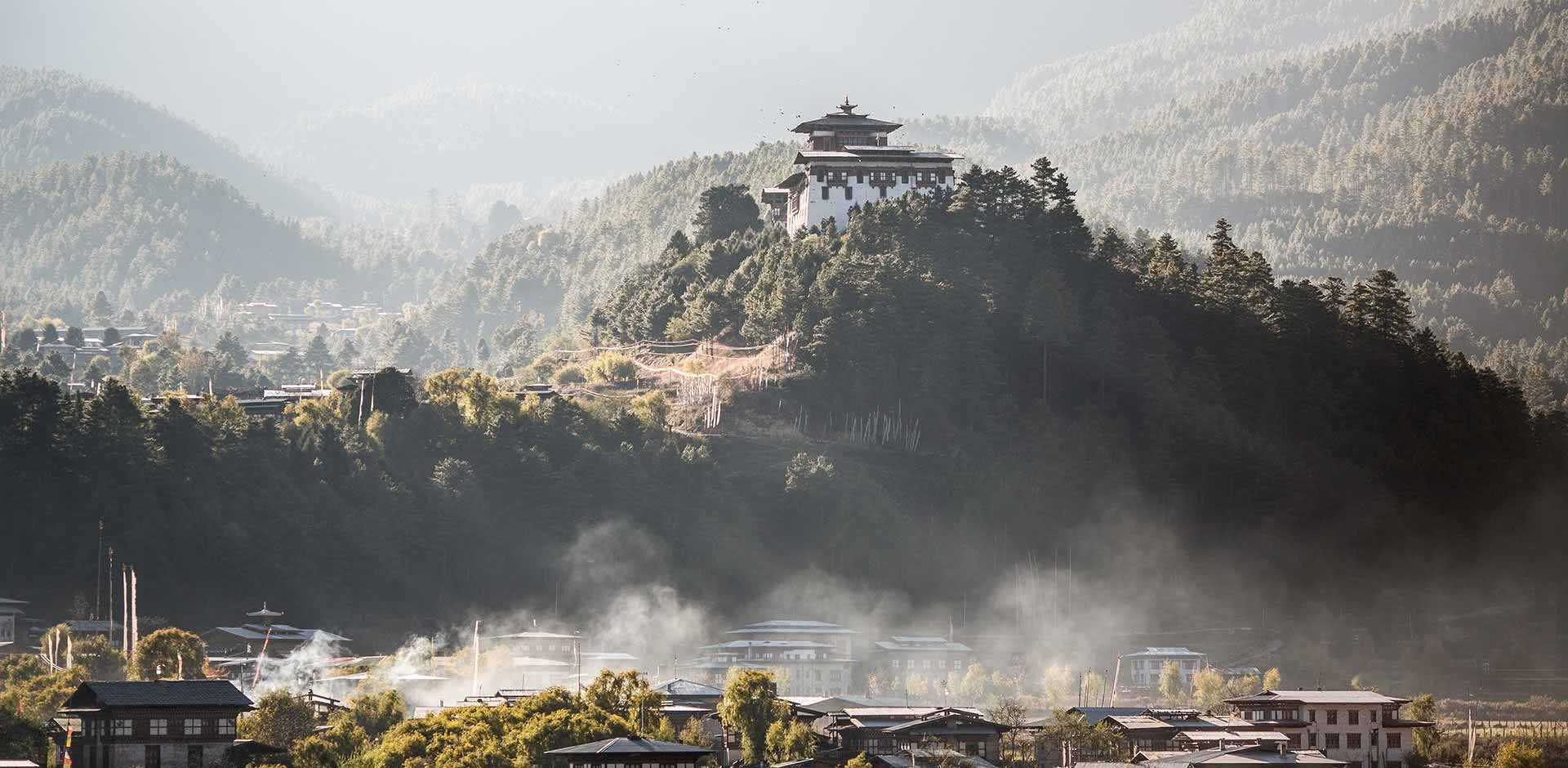
“Bumthang” directly translates as “beautiful field” – “thang” means field or flat place, and “bum” is said be an abbreviation of either “bumpa” (a vessel for holy water, thus describing the shape and nature of the valley), or simply “bum” (“girl,” indicating this is the valley of beautiful girls).
The district is sub-divided into the four blocks of Chokhor, Chumey, Tang and Ura. The valleys are broad and gentle carved by the ancient glaciers. The wide and scenic valleys draws a large number of tourists each year.
Roam Around ……..
Jambay Lhakhang: It’s one of the 108 monasteries built by King SongtsenGoenpo in the 8th century to subdue evil sprits in the Himalayan region.
Kurje Lhakhang: KurjeLhakhang is located just a few meters beyond JambeyLhakhang. It is dedicated to the saint Guru Padmasambhava who was supposed to have meditated there in 8th century.
Tamshing Lhakhang: This monastery lies on the other side of the river opposite the KurjeLhakhang. It was built in 1501 by TertonPemaLingpa, a re-incarnation of Guru Padmasambhava.The temple was restored at the end of the 19th century.
Jakar Dzong: The Dzong was initially built as a monastery in 1549by the great grand father of the Zhabdrung. It is now used as the administrative center for the Bumthang district. The BumthangTsechu is one of the most popular festivals. It is held mostly at night & is said to bring fertility to any woman wanting a child.
Namkhe Nyingpo’s Dratsang: Dratsang is a religious institution where monks study and religious ceremonies are performed as well.Thisdratsang is owned and headed by one of the most revered lamas, NamkheNyingpo. This is located just above the main town.
Wangdicholing Palace: This palace was built during the time of the first King’s father,JigmeNamgyel was used by the first King UgyenWangchuk as his main residence. This palace was also used by other kings.
Ura Village: Ura lies in the Tang valley, a one & a half hours drive from Bumthang town. The drive is mainly through sheep pastures & along the way one can glimpse magnificent view of the Mount GangkarPuensum from Ura la. The main characteristics of this village is the closely cluster houses.
Mebar Tsho (Lake of Burning Fire): This is a sacred lake of the Bhutanese who believe that PemaLingpa discovered religious treasures from this lake in the 12th century. On auspicious days many Bhutanese offer butter lamps on this fresh water lake.
Tharpaling Goempa: This goempa is located quite far from the main town and there is no road connecting this goempa. The trek to this goempa would take one day,going up and coming back.
Things To Do In The Bumthang……..
Bird Watching
Village Walk: One can delight in a walk through the forest of whispering blue pines, enlivened by the murmur of spring-fed brooks wandering through their rock-strewn beds, and the chatter of myriad birds. Visit a nearby village and experience a typical Bhutanese farm and village houses, getting a close look at the art of rural living.
Bird Watching: For those interested in bird watching, take a moment to discover and learn about different species. In the autumn months, the migrating Black-Necked Cranes migrate from Siberia and come to winter here, where they may be viewed in Bumthang.
Cultural and Photographic Tours: There are a good number of monasteries and historical places that are within walking distance. Your photographic tour begins as soon as you step out of your room, as the valley offers panoramic views that unfold before you.